Saturday, 17 May 2014

The Tragedy Of Peter Pan


Continuing my series of 1970's movies, I recently watched 'The Lost Boys', a BBC drama series made in 1978 about JM Barrie and his relationship with the Llewellyn Davies boys.

JM Barrie, the creator of Peter Pan, befriended the boys in Kensington Gardens while they were walking with their nanny. He endeared himself to the boys with his stories and playful antics and became a regular part of their lives. The boys lost both their parents in the space of three years and were eventually adopted by Barrie. Barrie was married to Mary Ansell, but their relationship was reportedly unconsummated and they didn't have any children of their own.
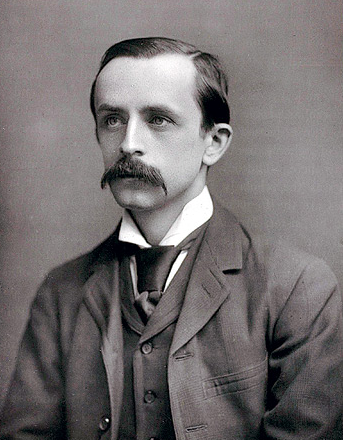
JM Barrie


There were five boys in total; George, John, Peter, Michael and Nico. The boys' relationships with Barrie varied. George and Michael were very close to him, but Jack harboured some resentment towards him for taking his father's place. Peter was ambivalent, but Nico adored him. Although it was Peter who gave his name to Barrie's alter ego, Michael and George are widely reported as being the ones who most influenced Peter Pan's portrayal.

Although there has often been suspicion about the nature of Barrie's relationship with the boys, there is no evidence of anything sexual. As an adult, Nico, the youngest of the boys, flatly denied any inappropriate behaviour and is quoted as saying that “he didn't believe 'Uncle Jim' ever experienced what one might call "a stirring in the undergrowth" for anyone — man, woman, or child.” But other contemporaries describe his relationship with the boys as 'morbid' and 'unhealthy'. Inevitably as the boys grew up, what once was fun and playful, now became oppressive and pathetic.

Three of the boys met a tragic end. George was killed in the Great War. Michael, who Nico described as "the cleverest of us, the most original, the potential genius” died aged 20 in an ambiguous drowning accident with a close friend (and possible lover) which many believe to have been a suicide pact. And Peter, who had always resented being associated with Peter Pan, committed suicide at age 63 by throwing himself under the train. At the time of his suicide, he had been editing family papers and letters, and had reached the documents relating to Michael's possible suicide. This may have sparked off his depression, but other possible contributing factors were his ill health (he was suffering from emphysema), and the knowledge that his wife and all three of their sons had inherited the usually fatal Huntington's disease.
Michael: the cleverest of us, the most original, the potential genius
The general consensus seems to be that Barrie was a manchild who was unable to form deep and meaningful relationships with other adults. Like Peter Pan, he was stuck in a childlike world, loved and worshiped temporarily by other boys until they grew up and left him; a child trapped in a man's body.


All boys grow up. That's their tragedy
Except for one. And that's his.

Perversely, for Bobby Driscoll, the actor who voiced Peter Pan in Disney's 1953 version, it was growing up which proved tragic. He was a wonder child who starred in some of Disney's most popular live-action pictures, such as Song Of The South, So Dear To My Heart and Treasure Island and even won an Academy Juvenile Award for outstanding performance in feature films. But he was hit by a terrible bout of acne when he reached puberty and was unceremoniously dumped by the Disney Company when he lost his cute looks. He struggled to find acting jobs since and became heavily involved with drugs. He died aged 31 from heart failure, penniless and destitute. His body was found in an abandoned tenement in Manhattan, but it wasn't identified until a year later when his mother started looking for him and contacted Disney for a hoped-for reunion with his father, who was nearing death. This resulted in a fingerprint match at NYPD, which located his burial on Hart Island. 


Bobby Driscoll - the voice of Peter Pan


Monday, 5 May 2014

Why did Billy Joe McAllister jump off the Tallahatchie Bridge?


I was listening to this song on Graham Norton's radio show the other day and it occurred to me just how brilliant these lyrics are. Bobby Gentry does not use one word too many to describe the aftermath of a tragic suicide on a narrow minded community in a small Mississippi backwater.


A TV movie speculating why Billy Joe Mcallister may have jumped off the Tallahatchie bridge was made in 1976. (One of several movies made in the 1970's based on classic country songs like 'The Gambler', 'Harper Valley PTA' or 'The Coward of The County'). I haven't seen the film, but I've read the synopsis. It's an intriguing and plausible theory, but I won't tell you what it is. You're better off not knowing. 


The song isn't about why Billy Joe killed himself. It's about the fact that nobody but the narrator cares. It's about the burden she carries as her family sit around the table, eating black eyed peas, talking about how 'nothing ever comes to no good up on Choctaw Ridge', while she secretly mourns the death of a friend. It's about the small lives and narrow minds of a dusty delta town in the 1950's and two young misfit's desperate and hopeless desire to leave it all behind.

It is the right combination of narrative, atmosphere and intrigue.  It is story telling at its best.


Friday, 18 April 2014

Memories – misty, water colored memories.


I have a huge collection of dvd's and watch a different film every night. I have a rather anal and overly complicated process for deciding which film to watch next. I will not bore you with the details of how my viewing list is compiled, but I will tell you that at the moment I'm watching a series of films from the 1970's and yesterday's movie was 'The Way We Were' - a much maligned romantic classic from 1973 starring Barbra Streisand and Robert Redford.

It's the 1930's and Streisand plays Katie, a difficult, unpopular, loud mouthed, socially awkward, humorless, frizzy-haired, Jewish girl who hides her insecurities behind witty retorts and a hectic lifestyle. In college she is constantly ridiculed for her passionate campaigning for the Young Communist League.

Redford plays Hubbell, a good looking, waspish college jock. He is a talented writer to whom everything comes easily. He is charming and aloof but there's a general air of discontentment about him. A feeling of not being worthy. A lack of struggle.

Opposites attract and after college, in the 1940's, Katie and Hubbell fall in love. She loves him for his talent and the ease with which things come to him, and he loves her for her never ceasing passion for her political ideals and steely determination to set wrongs right.

Hubbell writes a successful novel which gets optioned by Hollywood and they move to California where the relationship soon begins to sour. As the film studio savages Hubbell's book, there's a nagging and growing feeling between the two of them of having sold out. They plan to leave it all behind as soon as they have earned enough money and move to Paris to live as artists and bohemians, but it soon becomes apparent that Hubbell is reluctant to abandon his successful career. Things come to a head when Katie joins a demonstration against the House on Un-Amercian Activities Committee in Washington. Hubbell becomes scared that her political activities will damage his career and result in him being blacklisted. Realizing that the relationship is going nowhere, Katie and Hubbell eventually decide to split up.

The film is essentially about a plucky young Jewish woman who secretly longs to be accepted into the mainstream and rebels in order to attract attention; and a talented young WASP who is bored with the establishment and secretly longs to step out of his safe, little circle, but doesn't dare to. 

It is the 1950's now and  Hubbell is working for television. He is successful, but he still feels like a lucky faker. That nagging feeling of having sold out, of not daring to daring to take chances, of being cursed by having it easy, has never left him. Suddenly he sees Katie outside the television studio, protesting against nuclear weapons. He smiles. 

“You never give up, do you?” he says as he walks towards her. There is a look of admiration in his eyes. She is taken aback by his sudden appearance, but delighted to see him again after all this time.
“Only when I'm absolutely forced to,” she replies. “ But I'm a very good loser.”
“Better than I am,” he laughs bitterly.
“Well... I've had more practice.”

Admittedly the film looks a little dated and the sound track is a little corny, but once you get past all that, this is an intelligent love story - the likes of which are not made any more - about an insecure outsider struggling to get in, and a confident insider struggling to get out.